

 For two decades, enterprise software has been built around a simple assumption: people log into multiple applications to retrieve information, make decisions, and complete work. A CRM, a project tracker, a business intelligence dashboard, a support ticketing system, and more. All this is because these applications operate in isolation.
There is a shift whose intention is not eliminating SaaS applications. It’s about eliminating the need to constantly switch between them.
Why Dashboards Existed
Dashboards were built because software couldn’t interpret business intent. Humans had to retrieve, interpret charts, and decide what to do next. While dashboards were designed for human navigation, these static SaaS front ends are being replaced by dynamic, real-time interface synthesis.
The dashboard model worked when companies relied on a handful of applications. Today, enterprises manage hundreds of SaaS tools. An average large enterprise runs multiple SaaS applications – about 291 with large organizations scaling over 400. This makes constant switching a productivity problem rather than convenience.
A Harvard Business Review study revealed that digital workers toggle between different applications and websites about 1,200 times a day. This tool-switching alone costs employees an average of 44 hours per year due to tool fatigue. Meanwhile, most of the enterprise SaaS stack goes completely unused, and this is a weighty business cost.
What is Actually Changing
The shift in business computing is not about adding another dashboard to the stack, but rather usurping its purpose. The enterprise interface is beginning to shift toward intent-native workspaces, reducing the need to navigate traditional dashboards for routine work.
In comes agentic AI, which collapses the decision chain. Instead of opening a chart to figure out what it means, the user states an intent and an agent queries the underlying systems directly, synthesizes across them, and gives the user an answer or takes the action itself. For example, instead of a user logging into five different systems, a finance agent pulls real-time vendor invoices from an ERP, a legal agent scans contract terms, and a risk agent cross-references historical delivery delays. All coordinated by an orchestration layer.
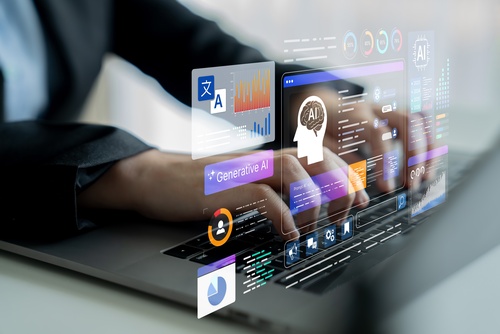
Generative user interface (GenUI) technology pairs with this orchestration. Instead of presenting the same dashboard to everyone, a GenUI system generates a temporary interface tailored to the user’s immediate request. Once the task is complete, that interface disappears. If a user inputs their intention, such as checking which supplier poses a risk, the system dynamically renders a clean, interactive panel showing only the relevant vendor risk scores.
A survey by CrewAI on 2026 State of Agentic AI Survey found that adoption of agentic AI is moving fast. Of the 500 senior enterprise executives surveyed, 65 percent are already using AI agents, 81 percent have fully adopted and are actively scaling, and 100 percent plan to expand agentic AI use in 2026.
What Still Matters
Dashboards aren’t disappearing; their role is changing. The shift is not toward a better dashboard; it is to create systems that decide and act directly, with humans overseeing outcomes and not every step. Modern AI-driven operations demand speed that previous tools can’t cope with. Having insights without action is now a bottleneck. Static views, manual interpretation, and the lack of proactive alerts and personalized framing are limitations that drive the shift toward agents.
However, while agentic AI determines what happens next, the dashboards will keep documenting the process. They will also exist mainly as audit trails and compliance records, but not as the primary way work gets done.
What This Means for Your Business
For businesses evaluating software, appearance is becoming less important than accessibility. A polished dashboard matters little if AI agents can’t access its data or trigger actions. As enterprises increasingly rely on AI agents to automate work across multiple systems, software without strong AI integration risks becoming difficult to use, costly to upgrade, and easier to replace.
Logistically, this means businesses should start auditing their software stack for API maturity and AI agent readiness. Before renewing or purchasing new software contracts, a business should evaluate whether the platform has robust APIs, allows AI agents to securely access its data and perform actions, and is built to support an AI-driven workflow.
Conclusion
The biggest disruption is not the end of SaaS dashboards – it’s the end of software that waits for human input. The next generation of enterprise software won’t compete on who has the prettiest dashboard. It will compete on which platform gives AI agents the fastest, safest access to data and actions. Businesses that continue buying interfaces instead of intelligent access may soon find themselves paying for software no one opens.